
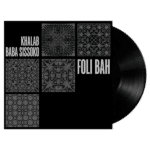


A Side: a1 Filani Donkono 8:09 / a2 Hame 8:45
B Side: b1 Denifurula 5:56 / b2 Nimamasa 6:00 / b3 Sebaya 6:36
When Khalab and Baba Sissoko first recorded together in 2015, they produced something definitive: a record where electronics and griot tradition achieved genuine synthesis rather than polite cohabitation. Not layered genres maintaining separate identities, but two forms evolving into something singular. “Tata” took Track of the Year at the 2016 Gilles Peterson Worldwide Awards, found champions in Laurent Garnier, Ben UFO, Matthew Dear, Bonobo, and many others — but more significantly, it established a working method built to last.
Eleven years on, they return with Foli Bah on Hyperjazz Records. Theirs is a relationship built on trust. Khalab constructs structures that don’t develop linearly but spiral inward — loops that reveal something new with each rotation, tightening until the listener stops resisting and surrenders. Sonic architectures that don’t expand outward but deepen over time, layering toward saturation. Baba Sissoko inhabits these structures with instruments from Malian tradition, not as ornamentation but as load-bearing elements: the tradition becomes structure, not decoration. Electronics and griot practice stop negotiating terms and start speaking the same language. Foli Bah carries weight beyond sound. The five tracks bear Bambara titles invoking universal themes: power as self-determination, destiny that overturns judgment, coexistence as political and cultural choice, possibility that remains open as long as there is life, and trust as the foundation of relationships. These aren’t narrative songs but states of being enacted through tension between Khalab’s obsessive repetition and Baba’s improvisational presence. The trust between the two musicians’ mirrors that between communities who choose to remain united; the hypnotic repetition of the loops is the same persistence that keeps the possibility of change open. Khalab — founder of Hyperjazz Records — brings compositional maturity refined through years of exploration: from the Afrofuturism of Black Noise 2084 to recordings in the Sahara Desert with Tuareg musicians for M’berra (Real World Records), to collaborations with leading figures in contemporary jazz, including Shabaka Hutchings and Moses Boyd. Baba Sissoko, master of the tamani and pivotal figure in Malian musical culture, has worked with the Art and genres without losing the centre of his artistic identity. Hyperjazz Records exists to pursue this exact convergence — building a catalogue that connects distant scenes without flattening difference.
Foli Bah is perhaps its most direct expression. Eleven years later, the dialogue continues from where it never stopped.
Credits All tracks written and arranged by Khalab & Baba Sissoko
Produced by Khalab
Lyrics by Baba Sissoko
Khalab – electronics
Baba Sissoko – voice, nogni, tama, doun doun, djembe, kalimba, karagnan
Mixed and mastered by Giuseppe Tillieci at Enisslab, Rome (2026)
Graphic design by Viola Masella
Artist biographies
Behind Khalab is Raffaele Costantino, producer, and sonic researcher. His music explores the infinite contaminations between electronics and jazz through contemporary, visionary language. An artistic path that moves seamlessly between ancestral practices and future possibility, building sonic bridges across continents and cultures. He has released work through internationally respected labels including Black Acre and On The Corner/!K7 (UK), Wonderwheel (USA), Peter Gabriel’s Real World Records, and his own Hyperjazz imprint, earning consistent support from influential media including BBC Radio, NTS, Worldwide FM, The Wire, The Guardian, and Mojo.
Among his most significant projects: a collaboration with the Tuareg community in a Mauritanian refugee camp, documented in a special release for Real World Records. Recent years have seen him perform at festivals including Glastonbury and Shambala (UK), Worldwide Festival (FR), Serralves Em Festa in Porto (PT), Jaiyede Festival (DK), and Donau Festival (AT). Alongside his musical practice, Khalab hosts “Musicalbox” on RAI Radio 2, one of Italy’s longest-running radio programs, consolidating his role as cultural agitator and advocate within contemporary music.
Born in Bamako, Mali, Baba Sissoko is the undisputed master of the tamani (talking drum) and a central figure in contemporary African musical culture. Coming from a major dynasty of Malian griots, he revolutionised this ancient tradition’s role by introducing the tamani’s sound into modern music for the first time. An extraordinarily versatile multi-instrumentalist, he commands the ngoni, kamalengoni, guitar, balafon, calebasse, and hang, weaving traditional Malian rhythms (Bambara, Peul, Mandinghi, and Sonrai) together with jazz and blues sonorities to create a singular musical language. His international career has brought collaborations with artists including Dee Dee Bridgewater, Art Ensemble of Chicago, Rokia Traoré, Roberto Fonseca, Enzo Avitabile, Buena Vista Social Club, and Damon Albarn.
In 2018, he received the African Grammy “Obaland Music Awards” as best African jazz musician. His musical philosophy reflects the griot’s ancestral role: reconciling hearts through music, which for him represents the only eternal truth and the highest value of human love.
